
The Russian war in Ukraine has entered a sixth day, with reports that the Russian Army had set up checkpoints on the outskirts of the southern Ukrainian city of Kherson, a huge military convoy was massing outside Kyiv, and claims that Russian forces aim to encircle the port city of Mariupol on March 1.
Satellite images showed that the convoy of armored vehicles and artillery extending more than 65 kilometers was within a few kilometers of Kyiv in what Ukraine’s armed forces see as an attempt to surround and take control of the country’s capital and largest city.
Live Briefing: Russia Invades Ukraine
Check out RFE/RL’s live briefing on Russia’s invasion of Ukraine and how Kyiv is fighting and the West is reacting. The briefing presents the latest developments and analysis, updated throughout the day.
The developments came after cease-fire talks between Ukrainian and Russian officials on February 28 failed to reach a breakthrough, although each side agreed to continue negotiations in the coming days.
Ukrainian President Volodymyr Zelenskiy, who in a video address on February 28 directly appealed to Russian troops to ignore their orders and stop fighting, offered no details of the hours-long talks that took place in neighboring Belarus. However, he said, Kyiv was not prepared to make concessions “when one side is hitting another with rocket artillery.”
Zelenskiy said Kyiv was hit by three missile strikes on February 28, that hundreds of Russian saboteurs were roaming the city, and that taking the capital remained a “key goal” for Moscow.
“They want to break our nationhood. That’s why the capital is constantly under threat,” Zelenskiy said.
Ukraine’s air force reported that five Russian fighter planes and a helicopter had been shot down during aerial attacks over cities outside the capital on February 28, although the information could not be independently verified.
The air force command also said that a Russian cruise missile had been destroyed by a Buk anti-missile system and that Ukrainian jets had struck columns of Russian armored vehicles in the Kyiv and neighboring Zhytomyr regions.
Ukrainian warplanes also reportedly dropped bombs and fired missiles at Russian forces in areas outside Kyiv.
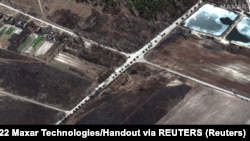
Latest Satellite Images Reveal Massive Russian Convoy Outside Kyiv
Satellite images from Maxar Technologies show that a convoy of Russian armored vehicles and artillery extended for more than 65 kilometers and was within a few kilometers of the Ukrainian capital, Kyiv, on February 27-28, in what Ukraine’s armed forces see as an attempt to encircle and take control of the country’s largest city.
Video images of fighting in the country’s second-largest city, Kharkiv, showed residential areas being shelled and apartment buildings shaken by powerful explosions. Reports that the northeastern city had been heavily bombarded had tempered optimism of an agreement.
Anton Herashchenko, an adviser to Ukraine’s interior minister, said dozens of people in Kharkiv had been killed in rocket strikes on February 28.
The head of the Sumy region, Dmytro Zhyvytskyy, wrote on Facebook on March 1 that more than 70 Ukrainian servicemen were killed when Russian troops shelled a military base in the town of Okhtyrka, located between Kharkiv and Kyiv.
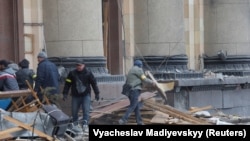
Death, Destruction As Russia’s Invasion Of Ukraine Enters Day Six
The Russian war in Ukraine has entered a sixth day, with reports that the Russian Army had set up checkpoints on the outskirts of the southern Ukrainian city of Kherson, a huge military convoy was massing outside Kyiv, and claims that Russian forces aim to encircle the port city of Mariupol on March 1.
In Kherson, a city located just northwest of the Crimean Peninsula illegally annexed by Russia in 2014, Mayor Ihor Кolykhayev wrote on Facebook that the Russian military was setting up checkpoints at the entrances to the city. Kolykhayev vowed that “Kherson has been and will stay Ukrainian.”
Mariupol has been left without electricity following attacks by Russian forces, according to Donetsk regional head Pavlo Kyrylenko, who wrote on Facebook on March 1 that Ukrainian forces still held the Azov Sea port city.
The head of the separatists in the eastern region, Denis Pushilin, said that the goal was to encircle the strategically important city by the end of the day.
Elsewhere, witnesses said a rocket blast set a building ablaze early on February 28 in the northern Ukrainian city of Chernihiv near the border with Belarus. Locals blamed the Russian military for the attack.
In his February 28 address, Zelenskiy appealed to invading Russian soldiers to lay down their arms.
“Abandon your equipment. Get out of here. Don’t believe your commanders. Don’t believe your propagandists. Just save your lives,” Zelenskiy said, adding that more than 4,500 Russian soldiers had already lost their lives during the Kremlin’s assault on the country.
There have been no independent confirmed numbers of casualties. Russia’s army on February 27 admitted for the first time that some of its soldiers had been “killed and injured,” but did not give any figures or further details.
Zelenskiy also said in his video address that it was time to consider imposing a no-fly zone for Russian missiles, planes, and helicopters in response to Russian shelling of Kharkiv. Zelenskiy said Russia had launched 56 rocket strikes and fired 113 cruise missiles against Ukraine.
Zelenskiy did not specify how and by whom a no-fly zone would be enforced. On March 1, British Deputy Prime Minister Dominic Raab rejected calls for NATO to enforce a no-fly zone, saying it would risk widening the war and put the Western military alliance in direct conflict with Russian forces.
The U.K. Ministry of Defense said the same day that Russia had failed to gain control of the skies over Ukraine, forcing Moscow to shift to night operations to reduce its losses.