
Some of us may still practice the faith with which we were raised. Others may have fallen away from childhood religion into agnosticism, atheism, or indifference. Still others may have converted to another creed. While all these shifts in religiosity are far from uncommon, one overarching fact remains: Religious practice in the United States over an individual’s lifetime is in decline.
The Institute for Family Studies and Communio recently released a report exploring the role that family life plays in raising children who maintain their religious practices into adulthood. While many children are raised with at least occasional worship attendance, rates of attendance face a sharp decline as these children become adults.
While only 9% of those surveyed never attended worship services in childhood, that number more than quadruples in adulthood, jumping to 41%. In other words, most children who are raised attending religious services never return to them in adulthood.
These statistics are far from encouraging to parents who wish to raise their children with strong, lasting religious convictions; indeed, these numbers make it evident that a significant portion of religious parents fail to encourage their children to maintain their faith.
The IFS and Communio found that the primary predictor for adult religiosity is not the quality of the churches or pastors with whom they interact, but the example of their parents. Parents who demonstrate “high religious importance” – namely, those who made faith a central part of day-to-day family life – are significantly more successful at raising children who truly love and understand their faith as adults.
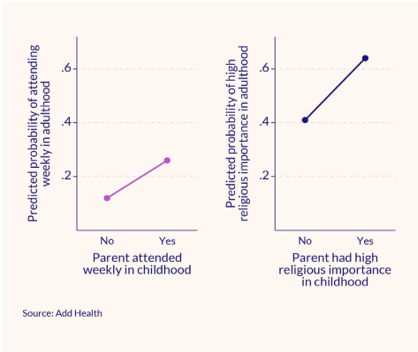
But what does “high religious importance” look like in practice beyond regular church attendance?
Family prayer, such as saying grace before meals, is one of the most important practices. Children whose families pray together are significantly more likely to pray daily, attend church at least weekly, believe in Jesus Christ as God, identify as Christian, and report that religion is important to them as adults.
While a portion of this finding is certainly correlational, it is hard to deny that forming habits of family prayer in childhood is not also causative of religious practice later in life. If communal prayer is a regular and important part of family life, the children of that family will learn through example and practice that religion is important, while also forming strong family bonds through regular and intentional family gathering time.
Yet leading by example is not always enough to encourage children to remain religious as adults. We’ve all likely encountered those who rejected their childhood faith because they never found satisfactory answers to their theological and moral questions – or were discouraged from asking questions at all. Children raised in households which encourage blind and unquestioning adherence to religious tenets are far more likely to reject faith later in life.
It is also vital that Christian parents engage with their children’s questions and make religion a normal topic of family discussion so that children can fully understand why they believe what they believe and how moral teachings play out in real life. “The relevance of Christianity in modern life isn’t affirmed by the larger culture, and if kids aren’t taught why and how faith matters, they are likely to assume that it does not matter,” the IFS writes.
Finally, the parents’ relationship with one another is a key factor in determining whether their children will practice religion. Children whose parents share the same religion and attend church services together are more likely to become religious adults. Intact and married families are more likely to attend church weekly. And the couples who are the most satisfied with their marriage are by far the most likely to discuss religion with their children openly and often.
Unsurprisingly, a child’s relationship with his parents is also highly determinative of whether he will share his parents’ religion later in life. Children with a good relationship with either their mother or their father are more likely to share their faith. But children who report a “very good” relationship with both parents are significantly more religious adults by every metric, as the following graphic shows:
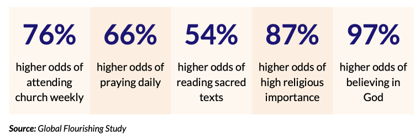
Raising religious children is a whole-family effort. Both parents individually play important roles in developing their children’s faith, but their relationship with one another and with their children is also key. Religious parents should be ready to platform their faith as the pinnacle of their family life, and their children will follow.
—
Image credit: Pexels